Cava
AI-based fitness & nutrition micro startup I created in 2024
Micro startup I founded with the goal of making personalised programmes easily accessible. Incredible learning experience.
Overview
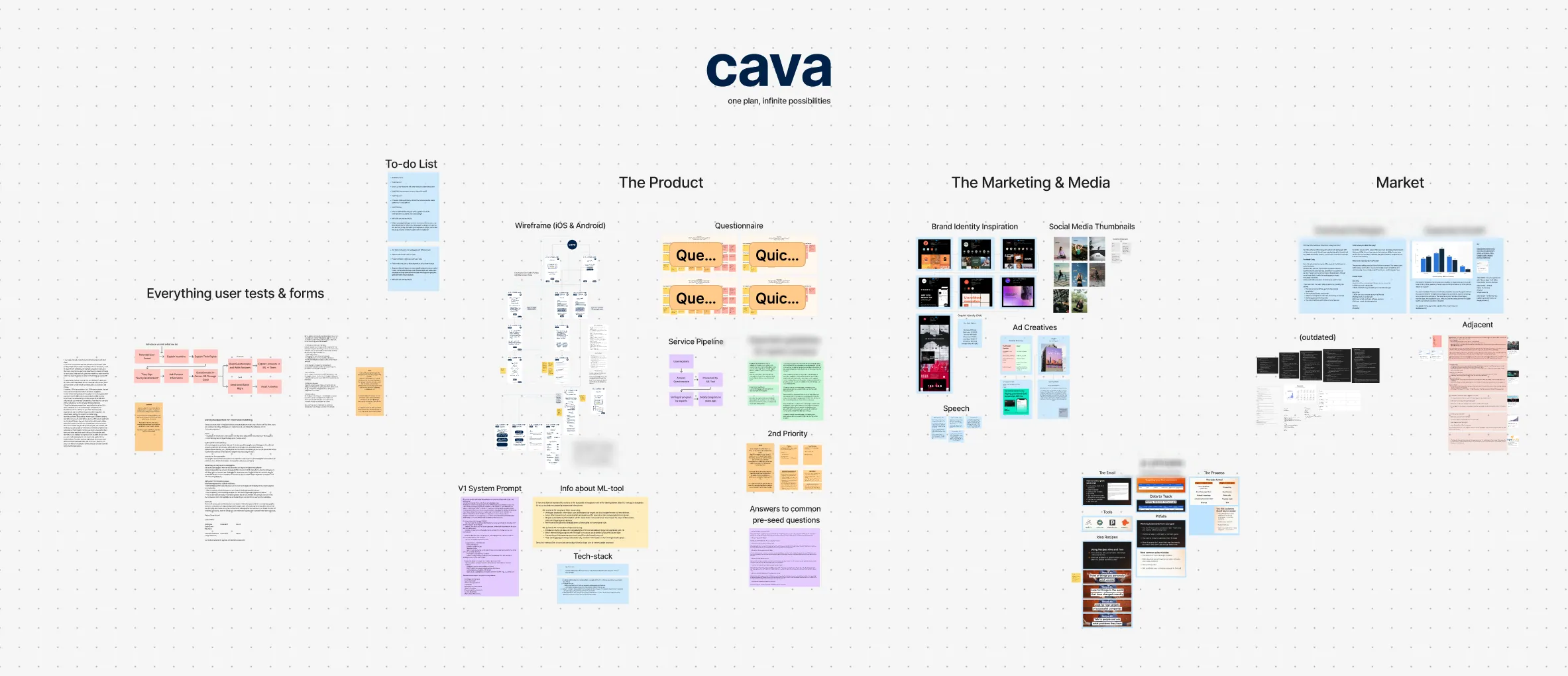
Cava was an AI-powered fitness and nutrition micro startup I founded in 2024, later bringing on a friend, with the goal of making personalised training programmes and nutrition plans easily accessible.
The product was built around an onboarding process that collected information about users’ goals, training history, dietary preferences and lifestyle. This information was used to generate individualised workout and nutrition plans. The process for plan creation would be the user data passing into two specialised LLMs, supported by curated fitness and nutrition data, where the drafts would then be vetted through actual, qualified experts… had we kept working on the project.
Beyond product development, the project involved my conducting user research, exploring product design, brand identity, marketing, business modelling and early-stage commercialisation. The whole thing was an incredible, and humbling, learning experience.
A big part of this experience was us entering into a startup competition called “för-orten.” It was a process that drove us to keep working and we ended up getting selected as one of the top 30 entries. We also participated in a venture capital coaching session which was a great experience.
External Perspectives
As part of Cava’s participation in the startup programme “för-orten” in 2024, it was selected as one of the top 30 entries. With that, I had the opportunity to meet with a venture capital professional for an individual coaching session.
The discussion covered everything from early-stage product validation and market positioning to networking, team building, customer acquisition and fundraising. Entirely based on the questions we brought.
Here are some of the key takeaways from then:
Validate early. Don’t spend too much time developing an idea in isolation. Get something in front of real users, collect feedback and allow actual behaviour to challenge your assumptions.
Find your differentiation. Understand your competitive landscape and identify what makes your solution meaningfully different. A good idea needs a compelling reason to exist.
Build relationships. Your network, customers and collaborators are among your most valuable assets. Be proactive about reaching out, asking for advice and maintaining relationships.
Understand the business. Product development needs to be accompanied by an understanding of market dynamics, customer acquisition and unit economics.
One of the most valuable aspects of the experience was getting an outside perspective on what it actually takes to build a company. It challenged assumptions I had made and it gave me a better understanding of all the things product ownership takes beyond developing the product itself.
Reflections & Learnings
Cava taught me product ownership, and it taught me that there is much more to it than just technical implementation. I gained experience in design, engineering, user needs, commercial viability, economics, and basic marketing.
The experience also gave me a better understanding of the importance of early validation, and challenging my own assumptions. When I first started teaching programming to youth, when I started building Cava, and when I took my first HCI course. Those experiences taught me so much. Back to Cava, it reaffirmed to me how much I enjoy taking an idea from concept to something tangible, and it gave me a clearer understanding of what I’d approach differently next time and how different personal projects can be from real products.